

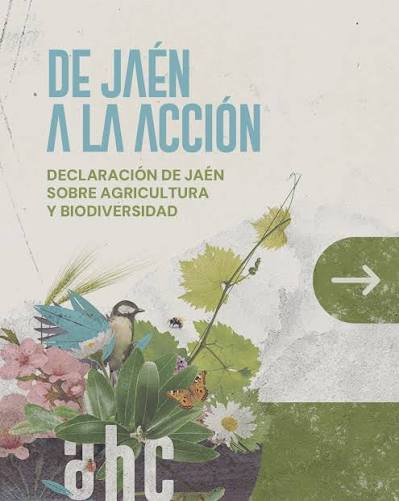
For too long, many agricultural models have treated nature as a constraint or a problem to be managed. The Jaén Declaration proposes precisely the opposite: without biodiversity, agriculture loses its capacity to remain productive, adapt and stay viable.
From a congress to a commitment
The Declaration emerged from the 1st International Congress on Biodiversity and Agriculture, held in Jaén in April 2026. The event brought together farmers, scientists, cooperatives, businesses, public authorities and civil society organisations, who agreed on a shared principle: food production and biodiversity conservation are not conflicting goals.
Neither a return to the past nor a rejection of innovation: the proposal is to make better use of what we already know, combining scientific knowledge, farmers’ experience, technology and solutions that work with nature rather than against it.
The challenge now is to ensure that these ideas do not remain merely conclusions from a congress.
What the Jaén Declaration says
The Declaration sets out ten principles and an overarching message that can be summed up in three statements:
- Without biodiversity, there is no viable agriculture.
- Without farmers and agricultural workers, agricultural biodiversity cannot thrive.
- Without coherence between policies, markets and society, the transition will not achieve the scale required.
You can read the full text on the Jaén Declaration website.
Biodiversity sustains agricultural production
Soil fertility, pollination, natural pest control and the capacity to retain water all depend, to a large extent, on the biodiversity present in agricultural systems. When this biodiversity is lost, costs increase, and farms become more dependent on external inputs and more vulnerable.
This is why the Declaration calls for biodiversity to be integrated into everyday farm management as part of the production system itself. In practice, this may involve decisions on ground cover, crop rotations, treatments, ecological infrastructure or water management, always adapted to each crop and territory.
Profitability and markets
Profitability cannot be measured solely by how much is produced in a single season. Reducing risks and costs, protecting the soil, improving stability and ensuring that biodiversity-friendly production achieves added value in the market are equally important.
And that added value must reach those who generate it. The Declaration advocates collective approaches, traceability systems and certification schemes that make it possible to demonstrate results and prevent greenwashing.
This is precisely the area in which Olivares Vivos works. Elisa Plumed, a journalist specialising in the agri-food sector, summed it up during the producers’ event held in September:
“If I had to come up with a headline for the event, it would be the importance of science in the Olivares Vivos certification: everything is carefully measured, certified and backed by evidence. I think that is the project’s greatest strength. The challenge will be communicating this to society, because we are living at a time when emotions influence us more than data. But we need to find a way to convey to people that these results have genuinely been measured and verified.”
This is the challenge addressed by the Jaén Declaration. It calls for biodiversity to be communicated in an accessible and tangible way, linking it to fertile soils, water, landscapes, birds and pollinators. It also stresses that consumers should be able to understand what lies behind a product, enabling them to make informed choices that support those who produce food while protecting biodiversity.
Public policies and generational renewal
For biodiversity conservation to become an integral part of agricultural production models, the necessary resources must be available. The Declaration calls for sufficient and stable public funding, with support linked to verifiable environmental and social benefits and adapted to the diversity of different territories. It also calls for less bureaucracy.
But less paperwork must not mean weaker environmental requirements. There is also a very practical issue: people must be able and willing to continue working in agriculture. Without generational renewal, training, advisory services and conditions that enable farmers to earn a living, there will be no one to carry this transition forward.
Why support the Jaén Declaration?
Because it places the viability of agriculture at the heart of the debate. Biodiversity is not presented as yet another obligation imposed on farmers, but as something that can help make farms more resilient, more stable and better functioning.
Because it does not place all the responsibility on farmers. Calling for greater biodiversity without advisory support, funding, incentives and a stable framework would be unrealistic. Change must involve the entire value chain.
Because it calls for evidence that measures actually work. It emphasises indicators, sufficient time to assess results and certification systems that make it possible to distinguish genuine improvements from mere statements of intent.
Because it provides a basis for decision-making. Public authorities, cooperatives, agri-food businesses and training institutions can use the Declaration as a common framework for action.
And because every endorsement strengthens its influence. The more farmers, scientists, organisations, businesses and citizens support it, the harder it will be for public authorities and market actors to ignore its proposals.
Who is the Declaration addressed to?
The Declaration addresses the entire value chain, with a role for every stakeholder.
Public authorities and European institutions responsible for the Common Agricultural Policy (CAP) are called upon to provide stability in policies and funding. Farmers and agricultural workers are encouraged to contribute their experience and lead implementation on farms.
Cooperatives and producer organisations are encouraged to promote collective approaches and strengthen farmers’ position within the value chain.
Agri-food businesses, retailers and the foodservice sector are called upon to differentiate and promote these products and ensure fair remuneration for those who produce them.
The scientific community and training institutions are encouraged to provide knowledge and training that can be applied in the field.
And citizens also have a role to play: their purchasing decisions can support those who produce food while protecting biodiversity, provided the information they receive is clear and truthful.
How to get involved
You can endorse the Declaration as an individual or on behalf of an organisation and choose whether your name appears on the public list of supporters. Before signing, you can read the full Declaration and the congress conclusions.
Endorse the Jaén Declaration → https://icba.es/en/jaen-declaration/

